Radiant Floor Heating, From the Slab Up
Loop spacing, the manifold, and why the decisions get made the day the concrete pours.
September 15, 2026 · 3 min read
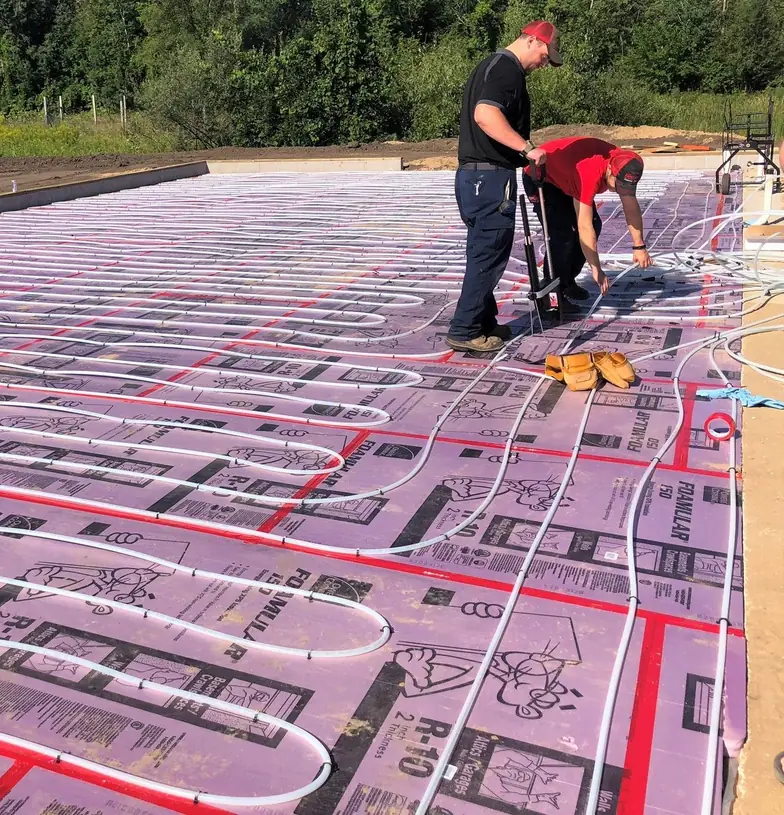
Radiant floor heating is one of the most requested systems we install, and it's also one of the least understood, because most of the decisions that determine how well it performs are made weeks before anyone can see a finished floor. By the time the concrete is poured, the loop layout is locked. Understanding what happens before that pour is the difference between a radiant system that heats evenly for decades and one that always has a cold spot nobody can explain.
Loop spacing decides everything
Before a single length of tubing goes down, we work out loop spacing for every zone in the slab, tighter spacing near exterior walls and large window areas where heat loss is highest, wider spacing toward the interior of the room. Get the spacing wrong and you either waste tubing and money heating a zone that never needed it, or you leave a corner of the room permanently cooler than the rest, and there's no fixing that once the pour is done. This is why we walk the plans with the builder before framing is even finished, not after.
The manifold is the control center
Every zone's tubing runs back to a manifold, the point where each loop can be balanced independently. This is what lets a bedroom on the north side of a house and a sunroom on the south side share one system while each gets exactly the heat it needs. A well laid out manifold also makes future service simple, a technician can isolate and test one loop without touching the rest of the house. On new construction, we set the manifold location early specifically so it's accessible for the life of the house, not tucked behind something that gets built around it later.
Why the slab is the point of no return
Once concrete goes over the tubing, the layout is permanent. There's no adjusting loop spacing after the fact, no relocating a run that got measured wrong. That's why the day before the pour is when we do a full pressure test on every loop, filling the system and holding pressure overnight to catch any leak while it's still sitting on top of open ground rather than buried under four inches of concrete. It's a slower step, and it's the one step in the whole install that can't be undone if it's skipped.
What happens after the pour
Once the slab has cured, the loops get tied into the boiler through the manifold, and each zone is balanced individually, adjusting flow at the manifold so a large open living area and a small bathroom on the same system both reach the right temperature rather than one overheating while the other lags. Startup is a gradual process too. A radiant slab is brought up to temperature slowly over the first cycle rather than all at once, which protects the concrete and lets us watch each zone respond before calling the system finished. This is also when we walk the homeowner through the manifold itself, so they know what they're looking at if they ever need to describe an issue to us over the phone.
Why homeowners in this area ask for it
Radiant heat pairs especially well with the kind of new construction we see across the Grand Traverse Region, homes on wooded lots with open floor plans and a lot of tile or stone flooring that would otherwise stay cold underfoot all winter. Instead of forced air blowing across a room, the whole floor becomes the heat source, which means no cold blast when the system kicks on and no drafts near doors and windows. It's a quieter kind of comfort, and once people have lived with it, they rarely want to go back to forced air alone.
What we tell every homeowner planning one
Get us involved before the framing is finalized, not after the slab is scheduled. The earlier the loop layout is set against the actual floor plan, window placement, and zone boundaries, the better the finished system performs, and there's no cost to having that conversation early. Once the concrete truck shows up, the design conversation is over.
Comfort Heating Inc, (231) 888-0293
Call (231) 888-0293