Tank or Tankless: What Actually Fails in a Retrofit
It's not the unit that fails a retrofit, it's the venting and the gas line.
September 15, 2026 · 4 min read
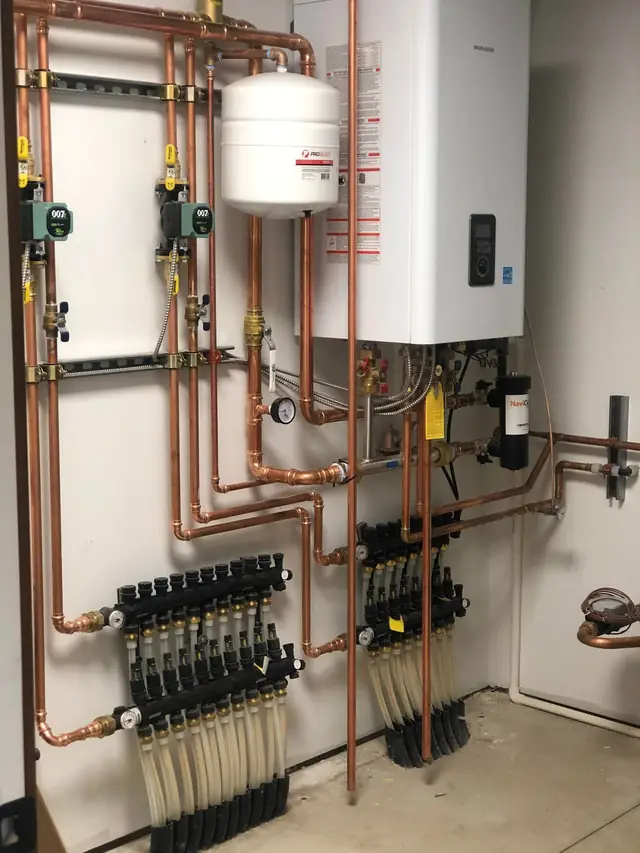
People usually come to us with the tank versus tankless question already half decided, they've read that tankless saves money and takes up less space, and they're not wrong. But the question that actually determines whether a switch works out isn't which unit to buy, it's whether the house can support it. As a Navien service and installation specialist, most of the retrofit problems we see have nothing to do with the water heater itself.
Recovery rate versus capacity
A tank water heater stores a fixed volume of hot water and recovers slowly, run through it during a full house of showers back to back and you'll eventually hit cold water while it catches up. A tankless unit doesn't store anything, it heats water on demand at a fixed flow rate, so its limit isn't volume, it's how many fixtures can draw hot water at the exact same moment. A household running two showers and a dishwasher simultaneously needs a tankless unit sized for that combined flow rate, not just sized for the house's square footage. Undersizing here is the single most common complaint we hear about a poorly planned tankless switch, and it has nothing to do with the brand.
Venting is where retrofits actually fail
A tank water heater typically vents through a simple flue. A tankless unit needs dedicated venting rated for its exhaust, usually a specific PVC or stainless configuration with defined length and elbow limits set by the manufacturer. In an older home, that often means running new venting through a wall or roof that was never built with it in mind. This is the step that gets skipped or shortcut in a bad retrofit, and it's also the step most responsible for early service calls afterward.
Gas line sizing, the quiet dealbreaker
Tankless units draw significantly more gas at peak demand than a tank unit does, because they're heating water instantly rather than maintaining a stored volume. A gas line sized correctly for the old tank is very often undersized for a tankless replacement, and running a high demand unit on an undersized line shows up as the unit struggling to maintain temperature under load, exactly the complaint that gets a new tankless system unfairly blamed for underperforming. Checking and, when needed, upsizing the gas line is not optional on most retrofits, it's part of doing the job correctly the first time.
Maintenance looks different too
A tank system's main maintenance item is the anode rod and periodic draining to clear out sediment. A tankless unit trades that for periodic descaling of the heat exchanger, since mineral buildup from hard water reduces efficiency over time in any tankless system regardless of brand. Neither is more work overall, but they're different work, and it's worth knowing that going in rather than assuming a tankless unit is maintenance free just because there's no tank to drain.
What a proper retrofit actually involves
Before we recommend a tankless switch, we look at fixture count and simultaneous demand, existing gas line size and length, and what venting path is realistically available given the house's layout. Sometimes that assessment points straight to tankless with no complications. Sometimes it means a larger gas line run or a specific venting path we plan out before the old tank ever comes out. Either way, the homeowner knows exactly what the job involves before we start, not after we've found a problem mid install.
The honest answer
Tankless isn't automatically the better choice for every house, and tank isn't automatically the safer one either. A well maintained tank system with a good recovery rate can serve a smaller household perfectly well for years. A tankless system properly vented and gas sized for actual peak demand will outlast it and cost less to run. The unit is rarely the deciding factor. The house's existing gas and venting infrastructure almost always is, and that's exactly what a real assessment should tell you before any decision gets made.
When a tank still makes sense
There are houses where a straightforward tank replacement is genuinely the right call, not a compromise. A vacation property used a handful of weekends a year, a smaller household with modest simultaneous demand, or a home where the venting run to the outside would be unusually long and expensive to build out correctly, all of these can make a tank the more sensible option even with tankless available. The point isn't to talk every homeowner into a tankless system, it's to size and vent whichever system goes in correctly for how the house actually gets used, not for how the sales brochure describes an average household.
Comfort Heating Inc, (231) 888-0293
Call (231) 888-0293