Why Northern Michigan Homes Get So Dry in January
It's not your imagination, and it's not solved by a space heater or a houseplant.
September 15, 2026 · 4 min read
If your skin cracks, your nose feels raw, or you're getting static shocks off every doorknob by January, it's not just the cold outside doing it, it's what your furnace is doing to the air inside. Cold outdoor air holds very little moisture to begin with, and once a furnace heats that air, the relative humidity drops even further. A house that felt perfectly comfortable in October can feel like a desert by midwinter, and it's one of the most common complaints we hear once the heating season is fully underway.
Why forced air makes it worse
Warm air holds more moisture than cold air, but a furnace doesn't add moisture, it just heats what's already there. So as outdoor air infiltrates the house and gets warmed, the relative humidity keeps falling even while the temperature feels fine. That's why a home can be a comfortable 70 degrees and still feel dry enough to crack wood floors, loosen furniture joints, and leave houseplants struggling, all while the thermostat says everything is working exactly as it should.
What it actually does to a house and to you
Beyond the obvious discomfort, dry winter air has real effects. Wood floors and trim can shrink and gap. Static electricity builds up enough to be genuinely annoying on carpet and around electronics. Dry sinuses and skin get more common, and some research points to dry air making it easier for airborne viruses to spread, which matters during the exact months everyone is spending more time indoors. None of this is solved by turning the thermostat down, since the moisture problem exists independent of temperature.
What a whole home humidifier does
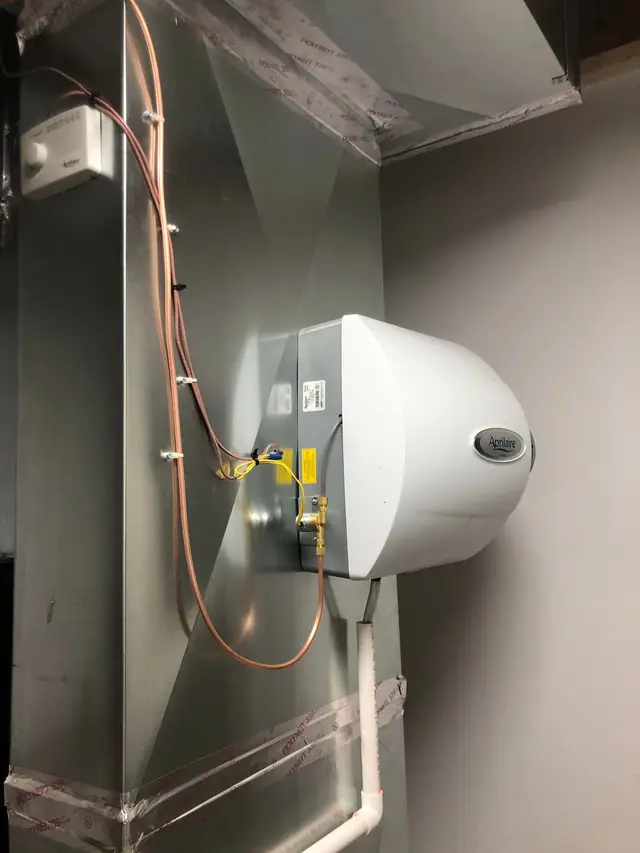
A whole home humidifier installs directly on the ductwork and adds a controlled, measured amount of moisture to the air as it circulates through the furnace, rather than treating one room at a time the way a portable unit does. It's tied to a humidistat, so it responds automatically to actual conditions instead of running constantly or being forgotten about. Aprilaire units, which we install regularly across the Grand Traverse Region, work this way, drawing water from a supply line and evaporating it into the airstream at a rate that keeps indoor humidity in a comfortable, healthy range through the coldest months.
How filtration and airflow tie into it
A humidifier doesn't operate in isolation, it's part of the same airflow system as your filter and blower. A clogged or undersized filter restricts the airflow the humidifier depends on to distribute moisture evenly through the house, so a fall filter change matters more than people realize once a humidifier is added to the system. Likewise, a blower that's struggling because of a duct restriction will move humidified air unevenly, leaving some rooms comfortable and others still dry. This is part of why we look at the whole system, filter, blower, and ductwork together, rather than treating a humidifier as a standalone add on.
Getting the level right
More humidity isn't automatically better. Set a humidifier too high during a stretch of especially cold weather and moisture can condense on cold window glass and inside exterior wall cavities, which over a winter can lead to mold rather than solve the dryness problem. A properly set humidistat accounts for outdoor temperature, running lower on the coldest nights and higher during milder stretches, which is exactly why a whole home unit tied into the furnace outperforms a portable humidifier left running on one fixed setting in a bedroom. Getting that balance right is part of the installation, not something left for the homeowner to guess at afterward.
Is it worth adding
For most homes in this region, yes. The winters here are long enough and cold enough that the dry air problem isn't occasional, it's most of the season. A properly installed and sized whole home humidifier, working with a system that's already moving air well, is a straightforward fix to a problem that a lot of homeowners have just learned to live with. It's worth asking about the next time a technician is already in your mechanical room for a fall tune-up, since the unit ties into the same ductwork and the same visit anyway.
A simple way to tell if it's already a problem
You don't need a meter to get a rough read on your house. If a wool sweater or carpet is giving you a static shock every time you touch a light switch, if a guitar or other wood instrument keeps needing tuned because the wood is moving, or if houseplants that did fine in fall are struggling by February despite normal watering, that's dry indoor air, not a coincidence. Those are the everyday signs worth paying attention to before reaching for a hygrometer, and they usually show up well before anyone thinks to blame the furnace for it.
Comfort Heating Inc, (231) 888-0293
Call (231) 888-0293